

My Career as Symphonic Poem or How I Learned to Apply Systems Thinking to Human Outcomes
© 2026 Russel Braga
Program Notes
I see what most miss: the same structural principles govern a symphony, a production line, and a college degree pathway. One must arrange elements within constraints and eliminate the unnecessary. Every component must be verified to serve as a whole, and then improve continuously. The grammar is the same; only the context changes. I am one person using the same structural intelligence in every domain I enter, and I choose domains where the structural outcome is a human protected, served, or elevated.
First Movement — The Core Principle
I see the world as a composer does, not metaphorically, but structurally.
In music, a composition works because its elements are arranged within constraints. These include harmonic rules, rhythmic logic, and formal architecture. Inspiration provides the impulse, but structure delivers the outcome. Consequently, a fugue is not a feeling. It is a system. Remove one voice and the counterpoint collapses. Add one voice carelessly and the harmony fractures. Every rest is intentional. Every entrance is timed. Structure in the creative process of art suggests that beauty is engineered.
I acquired this perspective at Dallas College where I earned an Associate of Arts in Music degree. I would later hone this worldview at the SMU Meadows School of the Arts, where I earned a Bachelor of Arts in Music degree with formal training in classical guitar performance, composition, and orchestration. I also completed a double major in Spanish from the Dedman College of Humanities and Sciences at SMU where I also immersed myself in Peninsular Spanish literature and Latin American poetry. This combined interdisciplinary study of arts and humanities formed my foundational lens. It gave me the ability to perceive structure beneath surface expression. I learned to recognize the hidden architecture that determines whether a system such as a musical composition, a poem, a production line, or a curriculum succeeds or fails.
This phase of my life was not training for a career in music. It was training in a way of seeing the world around me that would later govern my life and purpose.
Second Movement — The Framework Discovers Me
Some professionals spend years searching for their methodology. Mine found me in 2017 when I founded Allmigo® Allergy Friendly Foods, LLC.
The premise for me was personal and urgent. I needed to produce safe, allergen-free food at scale for people whose food allergies make ordinary eating a calculation of risk. For this population, the food supply chain is not a convenience. It is in fact a threat system. A single contamination event is not a quality lapse. It is a trip to an emergency room, or worse.
I responded the way an operational leader responds to a threat system: with process design. I earned an MBA and food safety and quality certifications. I served as both Senior Director of Manufacturing Operations, and head of Quality and R&D, owning the process and the product simultaneously. I designed allergen control systems with critical control points, documentation protocols, and zero-tolerance contamination standards. I conducted research and development to formulate allergen-free formulas and then engineered those recipes into scalable, repeatable manufacturing processes.
Lean Manufacturing was not a buzzword I adopted. It was the grammar I discovered I had been speaking all along. The same grammar of structure and constraint I had learned in orchestration, now applied to ingredient sourcing, production sequencing, and safety verification. The insight for me was immediate and permanent. I realized that the same structural principles that make a composition work are the ones that make a manufacturing process safe. One must arrange elements within constraints and eliminate the unnecessary. Most importantly, one must verify that each component serves the whole, document everything, and improve continuously.
Allmigo® Allergy Friendly Foods was my proof of concept, not for an allergen-free food company, but for a career philosophy: take rigorous operational frameworks and point them at human outcomes.
Third Movement — The Same Grammar, Different Score
Before the manufacturing floor and the food startup, there was the university.
As Program Director for the School of Health Science at a Texas public university, I oversaw academic quality, strategic growth, and faculty excellence across Ph.D., Master's, and Bachelor's programs. In between that role, I held Program Manager and Coordinator roles at two major community college districts in Texas. On paper, this was an academic administration career. In practice, it was the same framework deployed in a different key.
In manufacturing, a defect is a faulty unit: commonly defined as a product that fails specification. In education, a defect is a student who enrolls with aspiration and leaves without a degree. The waste is not scrap material. It is human potential, tuition dollars, and years of a person's life redirected into a path that didn't lead where they were told it would.
I saw this defect and responded not with policy statements but with process redesign. I implemented fast-track academic roadmaps that compressed time-to-degree by eliminating redundant sequencing. I also created workforce-to-academic pathways that translated employment experience into academic credit, recognizing that learning happens outside of classrooms too. I embedded industry certifications directly into degree programs, closing the gap between what a curriculum teaches and what a labor market rewards. I anchored each initiative I deployed to Labor Market Intelligence, the same demand-signal analysis a manufacturer uses to align production with customer needs. Except in academia, the customer was the economy and the output was an employable graduate.
I applied data analytics and strategic information systems to solve problems that had previously been addressed with intuition, tradition, or committee deliberation. I reduced defects (course dropout rates, failed progressions, administrative bottlenecks) by treating them as process failures with identifiable root causes, not as inevitabilities of the educational system. I optimized quality not by lowering standards, but by removing the friction that prevented capable students from reaching the standard.
Few educators think this way. Most speak of mission, access, and transformation in aspirational terms. Few manufacturers think about economic mobility. Most speak of yield, throughput, and defect rates in mechanical terms. I occupy the space between. I am fluent in both vocabularies, effective in both environments, committed to the idea that the distance between a production line and a graduation stage is shorter than anyone admits.
Fourth Movement — Operating at Scale
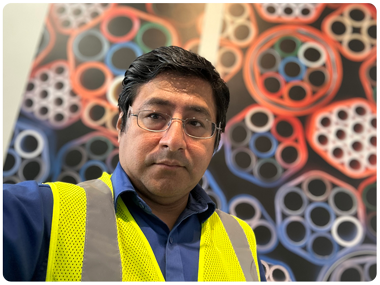
Today, as Senior Manufacturing Operations Leader for a global corporation, I oversee plant operations for the manufacturing of connectivity products within the telecommunications industry. The scale is larger than Allmigo® Allergy Friendly Foods. The systems are more complex than a university curriculum, and the corporate environment demands a different leadership register than either a startup or a faculty senate, but the work is recognizably the same.
I apply Lean and Six Sigma methodologies to production lines where the stakes are measured in yield rates, cycle times, and scrap costs. I also maintain TL 9000 conformance — the telecommunications quality standard built on ISO 9001 — meaning that my production lines are audited against international benchmarks for process consistency and product reliability. I hold ISO 14001 auditor certification for Environmental Management Systems, extending my quality discipline beyond product output into the environmental footprint of the operation itself.
My auditor certifications are not decorative. They mean I can evaluate a system, not just operate within one. I can walk a production floor, a supplier facility, or a compliance review and say with documented authority: This process works. Here is the evidence. Here is what to fix when it doesn't. The capacity to hold the entire chain of evidence from design through audit is what separates a manager from a systems leader.
And my trajectory has forced me to develop every mode of systems leadership:
Architect — by designing every process from nothing at Allmigo® Allergy Friendly Foods where no inherited system existed.
Surgeon — by optimizing living systems at the global corporation where the line cannot stop for a rebuild.
Diplomat — by navigating academic governance to redesign programs without alienating the faculty who deliver them.
Each mode requires a different posture. Most operational leaders develop one, maybe two. I have developed and mastered all three because my career refused to stay in one lane.
Fifth Movement — The Credentials Tell a Story
Look at my certifications and a pattern emerges that is not accidental. TL 9000 Auditor (quality management for telecommunications manufacturing), ISO 14001 Auditor (environmental management systems), HACCP Certified (hazard analysis and critical control points for food safety), PCQI for Human Food (preventive controls qualified individual, FDA-aligned), Lean Six Sigma (defect reduction and process optimization).
Each certification represents a deliberate investment in auditable, verifiable, externally validated expertise, not informal competence, but documented authority. Furthermore, each one sits at a different convergence of quality, safety, and systems management. Together, they form a credential stack that says: I don't just practice quality. I can prove it, certify it, and teach others to sustain it.
My academic credentials reinforce the same pattern from a different angle. An Executive MBA from Texas Woman's University pursued in honor of my mother, wife, and three daughters. The MBA gave me the financial and strategic vocabulary to complement my operational fluency. The BA with double major in Music and Spanish from SMU gave me structural and cultural literacy. The Culinary Arts Certificate from Collin College gave me hands-on craft knowledge that directly informed my food manufacturing R&D. The Associate of Arts from Dallas College rounded out a foundation that is unusually wide for someone operating at my level — and that width is the point.
Even my PADI certifications (Rescue Diver, Advanced Open Water Diver, and Open Water Diver) follow the same logic: progressive, structured, externally certified mastery of a safety-critical skill set. Earlier I had acquired and held PADI Pros certifications for Open Water Scuba Instructor and Dive Master, and I don't acquire credentials casually. I acquire them in domains where competence has consequences, and I progress continuously until I can teach.
Sixth Movement — The Creative Thread
Throughout all of this, I have remained a working composer.
I am a member of ASCAP (the American Society of Composers, Authors and Publishers). My works have premiered at Doctoral Recitals at the University of North Texas, Masters Recitals at the SMU Meadows School of the Arts, and the Fine Arts concert series at St. Monica Catholic Church. My formal training encompasses classical performance, composition, and orchestration.
This is not a hobby bolted onto a professional life. It is the original grammar from which everything else grew. Composition taught me to think in terms of structure and outcome. Orchestration taught me to arrange independent elements into a coherent whole. Performance taught me to execute under pressure with precision and presence. These are the same cognitive patterns that govern my manufacturing process design, my curriculum architecture, and my quality system development.
The difference is that in music the outcome is aesthetic, such as an audience moved, or a moment elevated by artistic expression and use of dynamics. In manufacturing the outcome is operational: a product delivered or a defect eliminated. In education, the outcome is economic: a student who graduated and a life changed for the better. The structure of the work is the same. The stakes are what vary.
Recognizing this is what allows me to move between worlds without losing coherence. I am not a dilettante sampling disciplines. I am a structural thinker who has found the same underlying patterns in fundamentally different contexts and has learned to speak each context's language while keeping the framework intact.
Seventh Movement — The Constant
Thread a line through everything above: the music, the manufacturing, the food company, the university programs, the certifications, the diving instruction, and you arrive at a single consistent principle.
I live by and for The Way of Love — employing my God-given talents to serve others for the honor and glory of God alone.
This is not a tagline. It is a selection criterion. Every major decision in my career has been filtered through one question: Does this use what I am good at in service of someone who needs it?
The MBA honored three generations of women in my family: my mother, wife, and daughters. Allmigo® Allergy Friendly Foods served people whose allergies make eating dangerous, including my own daughter. The higher education work served students seeking economic mobility through degrees that lead to employment. The manufacturing work serves everyone who depends on reliable connectivity, which is nearly everyone in a connected economy. The music serves audiences and communities in churches, recital halls, and concert series. Even the scuba instruction I performed in my early career served by training others to survive in an environment that is inherently hostile to human life.
Remove my core principle and my career becomes incoherent: a scattered collection of unrelated pursuits across unrelated industries. Restore the principle and the career becomes legible: one person using the same structural intelligence in every domain he enters, and choosing domains where the structural outcome is a human protected, served, or elevated.
The domains change. The framework holds. The motivation is constant.
Eighth Movement — The Purpose and Meaning
I am an operational leader whose technical excellence is always in service of a human outcome, and whose human commitment is always expressed through operational excellence.
I have built systems from nothing and optimized them at scale. I have spoken the language of corporate executives, tenured faculty, plant floor operators, and consumers with threatening food allergies. I have earned the credentials to prove my expertise and the creative achievements to demonstrate my range. I have done this across manufacturing, food safety, higher education, and the arts, not because I lacked focus, but because my focus is on a principle, not a sector. I seek purpose.
Every domain of evidence proves I can do the job in front of me. I am someone who diagnoses systems fast, earns trust across stakeholder groups, and deploys disciplined frameworks that stick. I connect every metric I touch to the human–being I ultimately serve.
That is my thread and my narrative: This is me, Russel Braga — a practitioner of systems thinking applied to human outcomes.